
Developer tool / Verifiable change
Voyagerroc Forge
A change that carries its own proof: an open-source tool that runs locally.
Product facts
- Stage
- Open-source pre-release · runs locally
- Technology
- Node.js 24 · JavaScript · SQLite · Git
- Information checked
- 19 November 2026
Open-source pre-release · runs locally
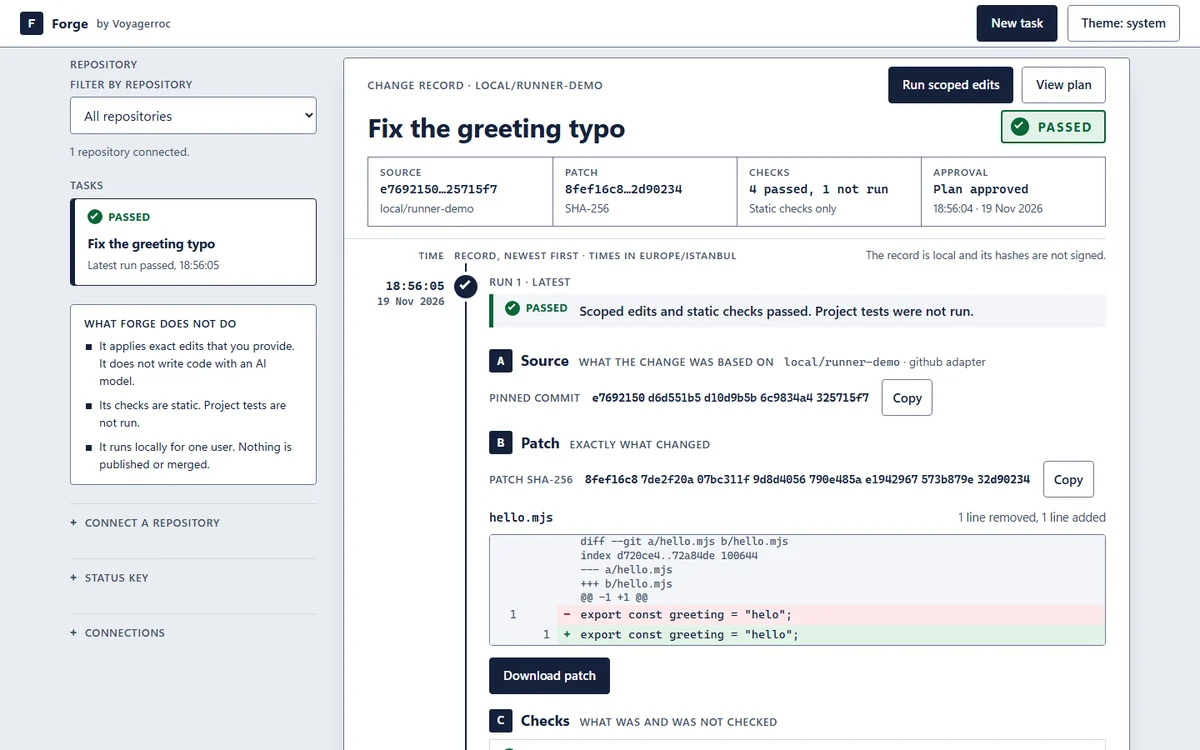
An open-source local tool that keeps each change in one record with the commit it was based on, the exact diff and its SHA-256, the named static checks that ran, what did not run and when the plan was approved; it exports the record as a portable evidence bundle and re-checks it independently.
The need
Writing a change has become cheap; trusting it has not. A reviewer has to ask separately what the change was based on, what exactly changed and what was tried.
Approach
A local application written for Node.js 24, with no npm runtime dependencies. The exact edits a user provides are applied to a disposable copy of the pinned commit; the record shows the source, the patch, the checks and the approval together. A finished run becomes an evidence bundle with npm run evidence:export. npm run evidence:verify then re-applies the patch to the pinned commit and re-runs the static checks.
Current scope and limits
v0.3.0 is a pre-release published on 19 November 2026; the source code is public under the MIT licence. The user provides the edits: Forge does not write code with an AI model. The checks are static (exact replacement, JSON validity, JavaScript syntax, conflict markers, whitespace errors); the project’s own tests are not run. It runs locally for one user; there is no hosted service today, and the server must not be exposed to the internet. The evidence bundle is not signed: it shows consistency, not who produced it. What is listed as planned is only planned: producing the evidence inside the maintainer’s own GitHub Actions run and signing through existing standards. The repository’s roadmap also mentions, conditionally and only if one ever comes, a thin hosted part for evidence pages and verification on which user code does not run; that is not a commitment. 115 tests run in continuous integration on Ubuntu and Windows; five outside contributors have had eleven pull requests merged.
Product information checked on 19 November 2026. Technical reviews of workflows carry their own dates. A reachable link does not mean every product workflow has been verified.
Two details of the record
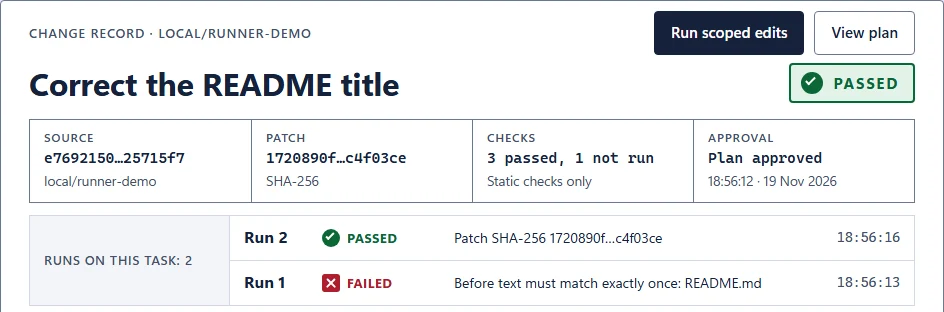
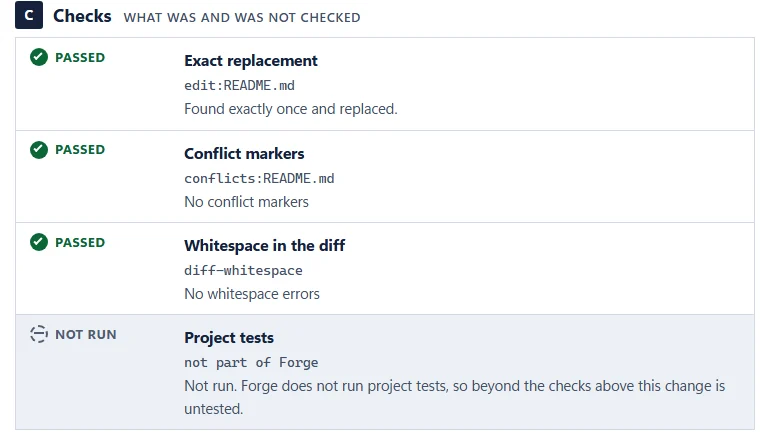
Reviewing a change together with its proof
It lets you review a change not only by its diff but together with the commit it was based on, the checks that ran and did not run, and the time the plan was approved. The aim is to make what the change rests on visible and re-checkable.
- Download the repository and start the demo with npm run demo:runner; the local address is 127.0.0.1:4317. No account, API key or npm install is needed.
- Open a new task and approve the plan, then provide the exact edits. The record shows the run as Passed or Failed, with the source commit, the patch and the checks.
- Turn the finished run into a bundle with npm run evidence:export; npm run evidence:verify re-applies the patch to the pinned commit and re-runs the static checks.
Frequently asked questions
Does Forge write code with an AI?
No. Forge applies the exact edits the user provides; it does not write code with an AI model. Its value is that it keeps a record of the change and makes it re-checkable independently.
Is Forge a hosted service?
No. Today it runs only locally, for one user, on the loopback address; do not expose the server to the internet. There is no hosted part. The roadmap mentions, only if one ever comes, a thin service for evidence pages and verification on which user code does not run; that is not a commitment.
What does the evidence bundle prove?
The SHA-256 of the patch, that the patch applies to the pinned commit and the re-run results of the static checks are verified. The plan approval time, the intent text and the other times are recorded but cannot be verified; the verifier lists them separately. The bundle is not signed: it shows consistency, not who produced it.
Does it run the project’s tests?
No. The checks are static: exact replacement, JSON validity, JavaScript syntax, conflict markers and whitespace errors. “Passed” means only that these checks passed; it does not mean the change is correct.
How can I contribute?
The repository has open issues labelled “good first issue” and “help wanted”. A good pull request is small and shows the commands you ran with their real results. Read CONTRIBUTING.md; no CLA or DCO sign-off is required.
Last updated: